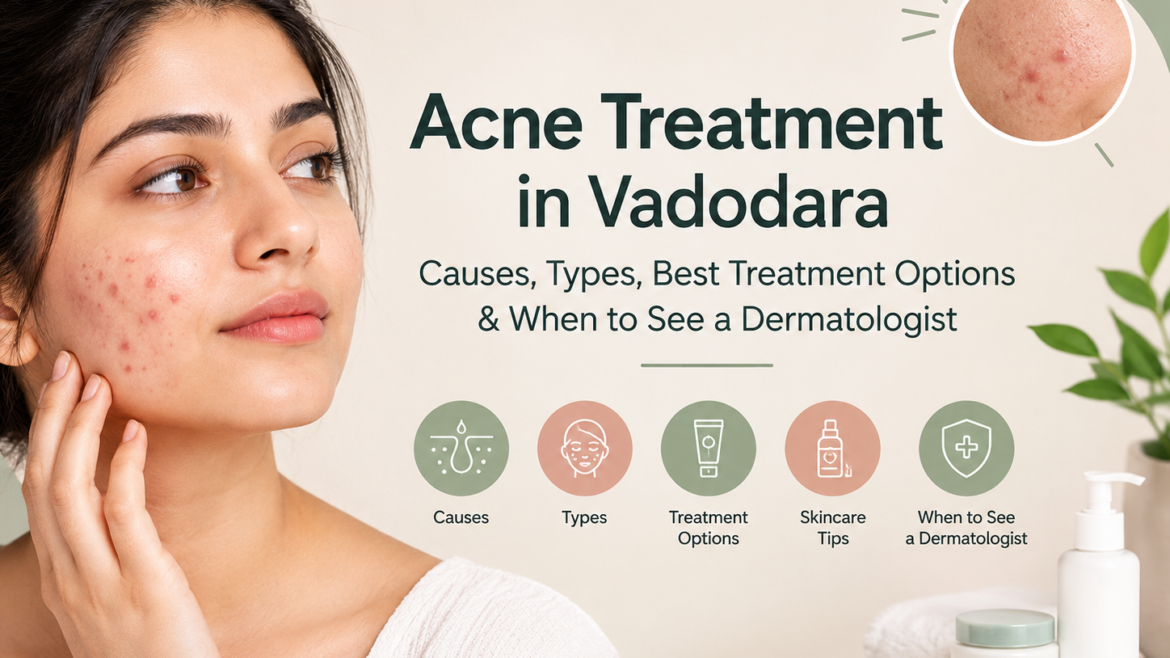
Acne is one of the most common skin concerns and can affect teenagers as well as adults. Pimples, blackheads, whiteheads, painful bumps and acne marks can be frustrating, especially when they keep coming back despite regular skincare.
If you are looking for acne treatment in Vadodara, the first step is understanding that acne is not the same for everyone. The right treatment depends on the type and severity of acne, your skin type, how long you have had breakouts, and whether acne is leaving behind dark spots or scars.
A dermatologist can assess your skin and recommend a treatment plan based on your individual concerns rather than relying on a one-size-fits-all approach.
What Is Acne?
Acne is a common inflammatory skin condition that develops when hair follicles become clogged with oil, dead skin cells and other debris. It can result in blackheads, whiteheads, pimples, nodules and cysts.
Acne commonly appears on the face, but it can also affect the chest, back, shoulders and other areas of the body.
Not every acne-like breakout is necessarily acne. Conditions such as folliculitis and perioral dermatitis can sometimes look similar, which is why persistent or unusual breakouts may need professional evaluation.
What Causes Acne?
Acne can develop due to several factors working together. Common contributing factors include:
Excess oil production
Sebaceous glands produce sebum, an oily substance that helps protect the skin. Excess sebum can contribute to clogged pores and breakouts.
Clogged pores
Dead skin cells can accumulate inside hair follicles. When combined with excess oil, this can result in blackheads, whiteheads and other acne lesions.
Inflammation
Inflammation plays an important role in acne, particularly when pimples become red, swollen or painful.
Hormonal changes
Hormonal fluctuations during puberty, menstrual cycles and certain other stages of life can contribute to increased oil production and acne.
Genetics
People with a family history of acne may have a higher tendency to develop persistent or severe breakouts.
Certain medications and medical conditions
Some medications can contribute to acne-like eruptions. In some people, persistent adult acne may also be associated with an underlying hormonal or medical condition and may require further evaluation.
Skincare and cosmetic products
Heavy or pore-clogging products may worsen acne in some individuals. Using products labelled non-comedogenic can be helpful for acne-prone skin.
What Are the Different Types of Acne?
Understanding the type of acne you have helps a dermatologist decide which treatment approach may be appropriate.
1. Blackheads
Blackheads are open clogged pores. The dark appearance is caused by the contents of the pore reacting with air, not simply by dirt on the skin.
2. Whiteheads
Whiteheads are closed clogged pores that appear as small, flesh-coloured or white bumps.
3. Papules
Papules are small, raised and inflamed red bumps that can develop when the skin around a clogged follicle becomes inflamed.
4. Pustules
Pustules are inflamed pimples that contain visible pus.
5. Nodules
Nodules are larger, deeper and often painful inflammatory lesions. They may require prescription treatment to reduce the risk of long-term scarring.
6. Cysts
Cystic acne involves deep, painful lesions and can result in significant inflammation and scarring. Professional dermatological treatment is particularly important when acne is severe or persistent.
Acne Treatment in Vadodara: What Are the Treatment Options?
There is no single acne treatment that works for every person. A dermatologist may recommend one treatment or a combination depending on the severity and type of acne.
Current dermatology guidelines include several topical and oral treatment options for acne, including benzoyl peroxide, topical retinoids, azelaic acid and salicylic acid. For moderate to severe acne, prescription medicines may also be considered depending on the individual patient.
Topical acne treatments
Topical medicines are applied directly to the affected skin. Depending on the condition, a dermatologist may recommend ingredients such as:
- Adapalene or other topical retinoids
- Benzoyl peroxide
- Azelaic acid
- Salicylic acid
- Prescription topical antibiotics in appropriate cases
- Combination topical treatments
These medicines can work on different factors involved in acne, including clogged pores, inflammation and acne-associated bacteria.
Topical antibiotics should generally be used under medical guidance and are often combined with benzoyl peroxide to help reduce the risk of antibiotic resistance.
Oral medicines
Moderate or severe acne may sometimes require prescription medicines that work throughout the body.
Depending on the patient’s condition, a dermatologist may consider:
- Oral antibiotics for selected cases
- Hormonal treatment for suitable patients
- Isotretinoin for severe acne or acne that has not responded adequately to standard treatment
These medicines require medical evaluation and should not be started without professional guidance.
Chemical peels
Certain chemical peels may be used as part of an acne management plan. They can help remove excess dead skin cells and improve some forms of acne and post-acne pigmentation.
The appropriate peel and concentration depend on the patient’s skin condition and sensitivity.
Acne procedures
In selected cases, a dermatologist may recommend procedures as part of a broader treatment plan. These can include specific acne extractions, intralesional treatment for selected large inflammatory lesions, or other procedures depending on the diagnosis.
Procedures should be performed by appropriately trained medical professionals because incorrect treatment or aggressive extraction can increase the risk of irritation and scarring.
Laser and light-based treatments
Laser or light-based procedures may have a role in selected acne cases, but they are not automatically the first or only treatment for every patient.
A dermatologist can determine whether a procedure is appropriate based on the type of acne, severity, skin type and previous treatment history.
The American Academy of Dermatology notes that laser or light-based therapy may sometimes be included in an acne treatment plan, while emphasizing that acne treatment should be individualized.
Acne Treatment for Teenagers
Teenage acne is commonly associated with hormonal changes during puberty. Mild acne may sometimes respond to an appropriate skincare routine and topical treatment.
However, persistent, painful or severe acne should not simply be ignored.
Early professional treatment can help control active acne and reduce the risk of developing long-term acne scars.
Parents should also avoid forcing teenagers to use multiple strong acne products at once. Too many active ingredients can irritate the skin and make it harder to determine what is actually helping.
Adult Acne: Why Does It Happen?
Acne is not limited to teenagers. Adults can develop acne even if they had relatively clear skin during adolescence.
Adult acne may be influenced by hormonal fluctuations, stress, skincare products, medications, genetics and other factors.
In women, persistent acne accompanied by symptoms such as irregular menstrual cycles or increased facial hair may warrant discussion with a dermatologist about possible hormonal factors.
Adult acne can also leave behind dark marks, particularly when inflammation is significant.
Acne and Dark Spots: Are They the Same as Acne Scars?
No.
After a pimple heals, some people develop a flat brown, grey or reddish mark. These are often referred to as post-inflammatory marks or hyperpigmentation.
An acne scar is different. Scars can involve changes in the texture or structure of the skin, such as depressions or raised areas.
The treatment approach is therefore different.
The first priority is usually to control active acne. Once breakouts are under better control, a dermatologist can assess persistent marks or scars and discuss appropriate treatment options.
When Should You See a Dermatologist for Acne?
You do not necessarily need to wait until acne becomes severe before consulting a dermatologist.
Consider professional evaluation if:
- Acne keeps coming back despite regular skincare
- You have large or painful pimples
- Acne is leaving dark marks
- You are developing acne scars
- Breakouts are affecting your confidence or daily life
- Acne suddenly appears or becomes significantly worse in adulthood
- Over-the-counter products have not helped
- You are unsure whether the condition is actually acne
- You are considering prescription acne medication
- You are pregnant or planning pregnancy and want advice about acne treatment
Large, painful or deeply located acne lesions are more likely to require professional treatment, and some acne medicines are not appropriate during pregnancy.
How Long Does Acne Treatment Take?
Acne treatment usually requires patience.
It is common not to see major improvement immediately after starting treatment. Depending on the treatment and severity of acne, visible improvement may take several weeks.
The American Academy of Dermatology notes that patients may begin seeing fewer breakouts after around 6 to 8 weeks, while more significant clearing can take longer.
This is one reason it is important not to change products every few days or stop treatment too early unless your dermatologist advises you to do so.
What Should You Avoid If You Have Acne?
Some common habits can make acne-prone skin more irritated.
Avoid popping pimples
Squeezing or repeatedly touching acne can increase inflammation and may increase the risk of marks and scarring.
Avoid harsh scrubbing
Scrubbing aggressively does not remove acne. It can irritate the skin and potentially make breakouts more uncomfortable.
Avoid using too many active ingredients at once
Combining several strong products without guidance can cause dryness, burning and irritation.
Avoid unverified home remedies
Toothpaste, lemon juice and other DIY remedies are not reliable acne treatments and can irritate the skin.
Avoid using prescription medicines without medical advice
Acne medicines can have side effects and may not be suitable for everyone. Prescription treatment should be selected according to the individual’s skin condition and medical history.
Simple Skincare Tips for Acne-Prone Skin
A consistent skincare routine can support acne treatment.
Morning
- Use a gentle cleanser.
- Apply products recommended by your dermatologist.
- Use a non-comedogenic moisturiser if needed.
- Apply broad-spectrum sunscreen.
Evening
- Cleanse the skin gently.
- Apply prescribed acne treatment as directed.
- Use moisturiser if recommended.
Do not over-wash your face or scrub aggressively. Dermatology guidance generally recommends gentle cleansing and avoiding unnecessary irritation of acne-prone skin.
How to Choose an Acne Treatment Clinic in Vadodara
If you are searching for a skin clinic in Vadodara for acne, do not choose a clinic only because of advertisements or before-and-after photographs.
Look for a clinic where:
- A qualified dermatologist evaluates your skin
- The diagnosis is explained clearly
- Treatment is selected according to your acne type and severity
- Prescription medicines are provided responsibly
- Potential side effects are discussed
- Your progress can be monitored
- Acne scars and pigmentation are considered as part of long-term management
- Treatment recommendations are based on your individual needs
If you are searching online for the best skin clinic in Vadodara, the right choice should ultimately depend on the quality of dermatological evaluation, appropriate treatment planning and follow-up rather than a ranking or marketing claim.
Acne Treatment at TVAK Aesthetic, Dermatology & Laser Skin Clinic
At TVAK Aesthetic, Dermatology & Laser Skin Clinic, acne concerns are evaluated based on the individual’s skin condition, acne type, severity and treatment history.
Dr. Namrata Shukla, MBBS, MD Dermatology, provides dermatological care for skin concerns including acne, acne-related pigmentation and other skin conditions.
Depending on the patient’s needs, treatment may involve medical skincare, prescription medicines or selected procedures. The goal is not simply to treat individual pimples but to manage active acne, reduce recurring breakouts and help minimise the risk of post-acne marks and scarring.
If persistent acne is affecting your skin or confidence, a dermatologist can help you understand the cause and choose an appropriate treatment plan.
Final Thoughts
Acne is treatable, but the right approach depends on the individual. Mild occasional pimples may need a simple skincare routine, while persistent, painful or scarring acne may require professional dermatological treatment.
If you are searching for acne treatment in Vadodara, getting an accurate diagnosis is an important first step. Avoid repeatedly switching products or relying on unproven home remedies. A dermatologist can assess your skin and recommend treatment based on the type and severity of your acne.
For persistent acne, acne scars, pigmentation or recurring breakouts, consider consulting a qualified dermatologist at a reputable skin clinic in Vadodara.
Frequently Asked Questions About Acne Treatment in Vadodara
1. What is the best treatment for acne?
There is no single best acne treatment for everyone. Treatment depends on whether you have blackheads, whiteheads, inflammatory pimples, nodules, cysts or acne-related scarring. A dermatologist may recommend topical medicines, oral medicines, procedures or a combination depending on the severity and individual factors.
2. How can I permanently get rid of acne?
Acne can often be effectively controlled, but there is no universal treatment that guarantees permanent prevention of every future breakout. Consistent treatment, appropriate skincare and dermatologist-guided management can help reduce active acne and prevent new breakouts.
3. How long does acne treatment take to show results?
Many acne treatments require several weeks before noticeable improvement. Some people may start seeing fewer breakouts within 4 to 8 weeks, while clearer skin can take several months. Consistency is important, and your dermatologist may adjust the treatment based on your response.
4. When should I see a dermatologist for acne?
You should consider seeing a dermatologist if acne is painful, persistent, worsening, leaving dark marks or scars, affecting your confidence, or not improving with appropriate skincare. Deep or severe acne is particularly important to treat early because of the risk of scarring.
5. Can acne scars and dark spots be treated?
Yes, but acne scars and dark spots are different concerns and may require different treatment approaches. The first step is usually controlling active acne. Once breakouts are managed, a dermatologist can assess the type of marks or scars and recommend suitable treatment options.
6. Can I treat acne at home without seeing a dermatologist?
Some people with mild acne may benefit from suitable over-the-counter acne products and a gentle skincare routine. However, painful, deep, persistent or scarring acne may need professional treatment. If you are pregnant, planning pregnancy or taking other medicines, consult a dermatologist before starting acne medication.
About TVAK Aesthetic, Dermatology & Laser Skin Clinic
TVAK Aesthetic, Dermatology & Laser Skin Clinic provides dermatological and aesthetic skin care in Vadodara under the care of Dr. Namrata Shukla, MBBS, MD Dermatology.
For acne, pigmentation, acne scars, hair and skin concerns, a personalised dermatological assessment can help determine the most appropriate treatment approach.
Consult a dermatologist if your acne is persistent, painful or leaving marks and scars.